Alternative to IKEA Bunk Beds: 5 More Durable Canadian Options (and Why They’re Worth the Investment)
By Equipe Futon d’or
If you type “IKEA bunk bed” into Google, you’re not alone. Most people start with IKEA for one very practical reason: price — and the ease of buying. The goal is usually to optimize a bedroom, save space, and fit two children into the same room without blowing the budget.
But a bunk bed is not just another piece of furniture. It is subject to a lot of wear and stress: movement, jumping, climbing up and down, friction, screws needing tightening, moves, room reconfigurations, mattress changes — and it still needs to remain stable and safe for years.
That is where entry-level options sometimes begin to show their limits. When you invest in a bunk bed, you are really buying three things:
a structure that stays solid and does not shift,
modularity that adapts as your family evolves,
peace of mind: safety, stability, and durability.
At Futon d’or, we offer longer-lasting alternatives, including a selection of bunk beds made in Ontario by Crate Designs, a company that prioritizes quality and durability. Yes, the upfront investment may be higher than at IKEA, but the logic is simple: pay once, and pay well, rather than replacing a bed after a few years — or living with a frame that squeaks and becomes unstable over time.
Here are 7 more durable Canadian options to consider, with the details that truly make a difference in everyday life.
The Mission twin-over-twin is an exceptionally smart foundation because it was designed to adapt to real life. It is a model people love for both its understated style, which is easy to match with any décor, and its flexibility.
What makes it so compelling:
Removable ladder: you can install it on the front or at either end of the bed. In practical terms, this allows you to adapt the bed to the room layout, whether that means working around a wall, a window, a closet, or traffic flow.
Built-in safety: full-length rear guardrail plus a removable front guardrail.
Adaptable over time: the bed can be separated into two twin beds or configured as a loft bed. This is crucial if you want the furniture to grow with your children, or if you expect to change rooms in 2 to 5 years.
For anyone hesitating between “IKEA pricing” and a long-term purchase, the Mission is often the best compromise: a truly durable structure with a level of flexibility not always found in entry-level models.
2) Raised Mission Bunk Bed — comfort between the bunks (a detail that changes everything)
The raised version of the Mission adds 8 inches (20 cm) of space between the two beds. On paper, that may sound minor. In real life, it makes a huge difference.
Why it matters:
More room to sit on the bottom bunk without feeling cramped.
A more open, airy feel in the bedroom, especially in a smaller room.
Greater day-to-day comfort for reading, chatting, or doing a bedtime routine with a child.
If you want a bunk bed that remains pleasant to live with every day, and not just functional, the raised version is an excellent choice.
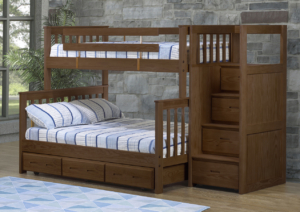
3) Mission with staircase and built-in drawers — the smart storage alternative
Many people go to IKEA to save money, then end up buying a dresser, bins, shelving, and baskets. The result: the room fills up fast.
The staircase with built-in drawers solves exactly that problem by turning access into a storage module.
What we love:
The staircase can be installed at either end of the bunk bed, so it can adapt to the room.
The solid wood drawers are dovetail-joined, a sign of strong craftsmanship, and glide on steel and nylon runners.
Each drawer makes full use of the available depth, and the bottom drawer can roll out on casters for easy access.
If your goal is a room that feels clean, organized, and easy to live in, this is one of the most convincing options — and exactly the kind of feature that justifies a higher investment than IKEA pricing.
4) Mission with underbed drawer / trundle — one piece of furniture, two functions
If you often host guests — friends sleeping over, cousins at the cottage, or visiting family — the drawer/trundle option is incredibly worthwhile. It can serve as everyday storage and convert into an extra bed whenever needed.
Practical details:
Slides underneath the bed on casters.
Can be used with dividers as a storage drawer, or fitted with a mattress when an extra sleeping space is needed.
The rollout side can be adapted to the room layout.
This is exactly the kind of option that transforms a children’s bedroom into a multifunctional room, without adding another bulky piece of furniture.
5) TimberFrame Twin Bunk Bed — a substantial, reassuring feel
The TimberFrame is for those who want a bunk bed that inspires confidence immediately. Its style feels more solid, more grounded. And that matters: a more substantial structure often creates both the impression and the reality of greater stability.
Why we recommend it:
Robust look and construction: ideal for older children, teenagers, or heavy everyday use.
Like the Mission, it can evolve with your needs through different configuration options.
It is the choice for people who want a bunk bed that will still be there 10 years from now.
6) TimberFrame with underbed drawer / trundle — added function without added bulk
The logic is the same as with the Mission: use the space under the bed instead of wasting it.
Why it works so well:
You turn otherwise unused space into practical storage.
Or you create an additional sleeping area without dedicating an entire room to it.
Especially appreciated in homes where space is limited, such as in Montreal, condos, or smaller bedrooms.
The angled ladder is an option people often underestimate. In some rooms, placing access in exactly the right spot makes all the difference when it comes to movement, closet doors, wall clearance, and overall layout.
If the built-in ladder does not work with your room configuration, the angled ladder may turn out to be the best design solution.
Let’s be clear: IKEA is often hard to beat on entry-level pricing. If your goal is a temporary solution for 2 to 3 years, or very occasional use, it can absolutely make sense.
But if you want:
a stable bed that will not require constant tightening,
modularity, such as separating into two beds or converting into a loft,
integrated storage options,
locally made quality,
then the equation changes.
The real question is: what does it cost per year?
A more durable bed that you keep for many years — and can reconfigure as needed — often turns out to be more cost-effective than a cheaper purchase that ends up needing to be replaced, or that pushes you to buy additional storage furniture.
Why buy these alternatives from Futon d’or?
Because a bunk bed is a technical purchase. At Futon d’or, we do more than simply sell you a bed — we help you choose the right configuration for your room and your needs:
ladder vs. staircase,
standard vs. raised version,
drawers vs. trundle,
and most importantly, the right mattress — including safe mattress height for the top bunk and proper support for children.
And if you are shopping for Crate Designs, you also get a clear advantage: we offer 10% off the suggested retail price, and we can guide you through the matching options available.
FAQ
Which model should I choose for a small bedroom?
Mission, with its removable and repositionable ladder, or TimberFrame with the access option best suited to your layout.
Which model is best for storage?
Mission with the staircase and built-in drawers: storage plus safer access.
Which model is the most versatile long-term?
Mission, because it can be separated into two beds or converted into a loft — an excellent adaptable investment.
How long is the lead time?
In general, allow 6 to 8 weeks depending on the selected options and finishes.
What you absolutely need to know before buying a futon, shikibuton, or mattress.
Sign up to receive 3 exclusive guides straight to your inbox — for free!
To provide the best experiences, we use technologies like cookies to store and/or access device information. Consenting to these technologies will allow us to process data such as browsing behaviour or unique IDs on this site. Not consenting or withdrawing consent, may adversely affect certain features and functions.
Functional
Always active
The technical storage or access is strictly necessary for the legitimate purpose of enabling the use of a specific service explicitly requested by the subscriber or user, or for the sole purpose of carrying out the transmission of a communication over an electronic communications network.
Preferences
The technical storage or access is necessary for the legitimate purpose of storing preferences that are not requested by the subscriber or user.
Statistics
The technical storage or access that is used exclusively for statistical purposes.The technical storage or access that is used exclusively for anonymous statistical purposes. Without a subpoena, voluntary compliance on the part of your Internet Service Provider, or additional records from a third party, information stored or retrieved for this purpose alone cannot usually be used to identify you.
Marketing
The technical storage or access is required to create user profiles to send advertising, or to track the user on a website or across several websites for similar marketing purposes.